
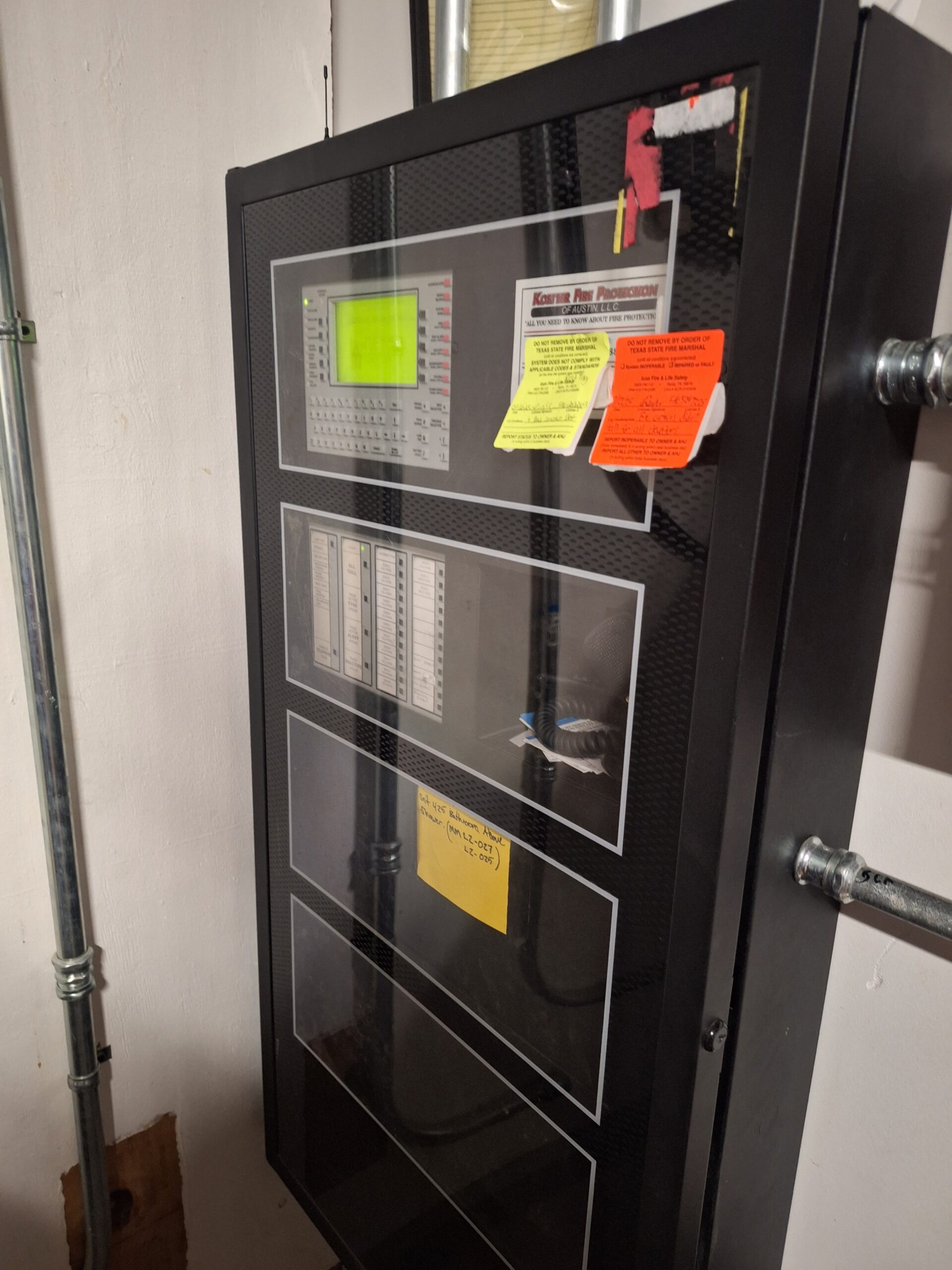
Are voice evacuation systems mandatory in Austin? Yes. If you manage an assembly occupancy, a downtown high-rise, or a large educational facility, the Austin Fire Department enforces the adopted International Fire Code and NFPA 72, which require a working voice evacuation system to pass your annual inspection.
In this post, we’ll break down exactly which buildings need these systems, why the Austin Fire Department (AFD) is cracking down on speaker intelligibility testing, and what to do if your current system is failing or missing it’s inspection.
A quick note on the jargon: If you are looking at your blueprints or a recent inspection report, you might see this referred to as an EVACS (Emergency Voice/Alarm Communication System). Don’t let the acronym confuse you, if the city is demanding an EVACS, this is exactly the system we are talking about.
A traditional fire alarm is like a car horn. It lets you know something is wrong, but that’s about it. A voice evacuation system (VES) is like GPS. Instead of just blaring a siren and causing a chaotic scramble for the stairs, it calmly cuts through the noise and tells your tenants exactly which exit to use and where to go. Because these systems require heavy amplification and digital message repeaters, they are notoriously finicky. Keeping them code-compliant requires more than just swapping a battery.
Why the Austin Fire Department Is Cracking Down
For decades, standard horns and strobes were enough. But as Austin has grown, so has the complexity of our buildings. Effective July 10, 2025, the City of Austin adopted the 2024 edition of the International Fire Code with local amendments. That means the standards your building is measured against are current, and that inspectors are actively enforcing them.
If a fire breaks out on the 10th floor of a downtown high-rise, evacuating all 30 stories at once is dangerous and clogs the stairwells for first responders. A voice evacuation system solves this with a phased evacuation. By automatically telling the fire floor and the floors immediately above and below to evacuate, while calmly instructing the rest of the building to shelter in place.
Because this communication is so critical to life safety, the local fire marshal will not hesitate to red-tag your panel if a single zone sounds muffled or fails to trigger properly. In fact when it comes to priorities the voice evacuation system is setup to shut off and overwrite the fire alarms in your building once it has been activated.
How do you know if you need a voice evacuation systems and what sorts of remodels could require that you add one? You generally need a fully functional voice evacuation system if your building is:
- A High-Rise: Any occupied floor 75 feet or higher above fire department vehicle access.
- An Assembly Occupancy: Large venues, concert halls, theaters, and mega-churches where panic control is critical.
- Educational or Healthcare Facilities: Places where occupants may need extra direction or physical assistance to evacuate safely.
Common Repair Issues: Why Voice Evacuation Systems Fail Inspections
Unlike basic fire alarm horns, voice systems run audio signals across massive lengths of wire. That makes them highly susceptible to environmental damage, power surges, and simple wear and tear.
Last month, I accompanied one of our techs on an inspection at a Hotel in Downtown Austin and they failed their annual walkthrough because the automated voice message sounded like a distorted drive-thru speaker echoing down the hallway. It took a little bit of troubleshooting to find the degradation, but we got them back in the green before we left.
If you’re staring at a yellow tag or a voice evacuation panel in trouble, it’s usually one of these three common failures:
1. Ground Faults on Speaker Circuits Because speaker circuits span the entire building (including harsh outdoor environments), a single pinched wire, leaky roof, or a rodent chewing a cable can ground out the circuit. This instantly throws a “Ground Fault” trouble code on your main panel and can silence an entire wing.
2. Blown Amplifiers Voice systems require heavy-duty amplifiers to push clear sound to dozens of speakers at once. Power surges from Texas thunderstorms, or years of continuous heat in a poorly ventilated electrical room, can fry these components, leaving your system muted during a test.
3. Dead Standby Batteries Heavy amplifiers drain batteries fast. NFPA 72 requires your batteries to hold the system in standby for 24 hours and still have enough juice to blast the evacuation message. If your batteries are older than three years, they will likely fail a load test. Not sure when yours were last swapped? Give us a call and we can test them.
Navigating Speaker Intelligibility Testing (NFPA 72)
One of the biggest traps for property managers during a downtown Austin high-rise voice evacuation test is assuming that “loud” means “compliant.” It doesn’t.
The fire code draws a hard line between audibility (can you hear it?) and intelligibility (can you understand the words?). The AFD uses a Speech Transmission Index (STI) meter to grade your system. If we want to get highly technical, NFPA 72 requires an average STI score of at least 0.50.
What does that mean for you? It means you can’t just crank up the volume to pass. In fact, cranking the volume on a bad speaker just distorts the message further and guarantees a failed inspection.
Many poor evacuation systems are the result of trying to compensate for an insufficient number of speakers with too much volume. At one end of the room people are asking “What did he say?” while people near the speaker are blasted with noise. When it comes to life safety, you don’t want to have to rely on the game telephone. You want everyone to get the clear and intended messaging. The general rule of thumb is that a lot more speakers at lower wattage taps are required for designing for intelligibility.
So, if the acoustic design of your lobby creates an echo that garbles the message, you’ll fail the inspection. Fixing it often means re-tapping speakers, adjusting amplifier outputs, or replacing blown cones. The good news: most failures are correctable without replacing the entire system.
Maintaining these systems is not a DIY job for a weekend maintenance crew. Staying ahead of city citations means partnering with a local fire protection company that knows exactly what AFD inspectors are looking for.
What Happens If You Don’t Comply
Ignoring a failed voice evacuation inspection isn’t just paperwork, it carries real risk:
- Repeat citations and re-inspection fees from the AFD.
- Certificate of Occupancy exposure for the property.
- Liability if the system can’t deliver an intelligible message during a real emergency.
- Your insurance may not cover you during a disaster
Given that this is a life-safety system, a garbled message during an actual fire is exactly the failure the code is designed to prevent, which is why inspectors treat intelligibility as non-negotiable.
Conclusion: Are Voice Evacuation Systems Mandatory in Austin?
Yes, they absolutely are if you manage a high-rise, an assembly occupancy, or a large educational facility. The Austin Fire Department does not play around when it comes to life safety and phased evacuations. If your panel is throwing a ground fault or your last intelligibility test sounded like a blown fast-food speaker, don’t wait for the fire marshal to red-tag your building. Call a licensed local technician to get it fixed.
5 Common FAQs About Voice Evacuation Systems in Austin
Are voice evacuation systems mandatory in Austin? Yes. If your building is a high-rise, a large assembly occupancy, or a major educational facility, the adopted International Fire Code and NFPA 72, enforced by the Austin Fire Department, require a voice evacuation system (EVACS) to be installed and fully operational to pass inspection.
How much does a voice evacuation system inspection cost in Texas? Pricing depends on the square footage of your facility and the number of amplifiers and speaker zones on your panel. Because these inspections require comprehensive audio testing and battery load tests across multiple floors, they’re typically more involved than a standard horn-and-strobe walkthrough. Contact us for a precise quote based on your building’s footprint.
Why does my voice evacuation panel say “Ground Fault”? A ground fault means bare wire somewhere in your system is contacting metal or exposed to moisture, causing current to leak out of the circuit. It’s extremely common after heavy rains or construction work and requires a technician to physically trace the wiring to find the short.
How often is speaker intelligibility testing required? Basic functional and visual inspections of the panel are performed annually. Full intelligibility testing (using an STI meter to ensure the words are clearly understandable) is typically required at initial acceptance, after major system upgrades, or when acoustic changes are made to the building.
Can you upgrade a traditional fire alarm to a voice system? Often, yes. Modern voice evacuation modules can be integrated into many existing fire alarm control panels. However, the notification wiring and devices must be swapped out, because standard fire alarm wire can’t carry heavy, amplified audio signals.